
Coastal Italian cuisine is a style of Italian cooking built around fresh seafood, olive oil, citrus, and simple herbs. It skips heavy cream sauces and leans on the ocean instead. At MiraMare Ristorante in Naples, FL, this cooking style shapes almost every dish on the menu, from a simple seafood starter on our menu to a full seafood pasta.
TL;DR
- Coastal Italian cuisine centers on fresh seafood, olive oil, citrus, and light herbs instead of heavy cream and red sauce.
- The style pulls from Liguria, Campania, Sicily, and Sardinia, each region adding its own dishes.
- MiraMare Ristorante in Naples, FL brings this cooking style to the Gulf Coast using local Gulf seafood.
- You can spot coastal Italian cooking on a menu by looking for crudo, branzino, and olive-oil-based sauces instead of cream sauces.
What Does Coastal Italian Cuisine Actually Mean?
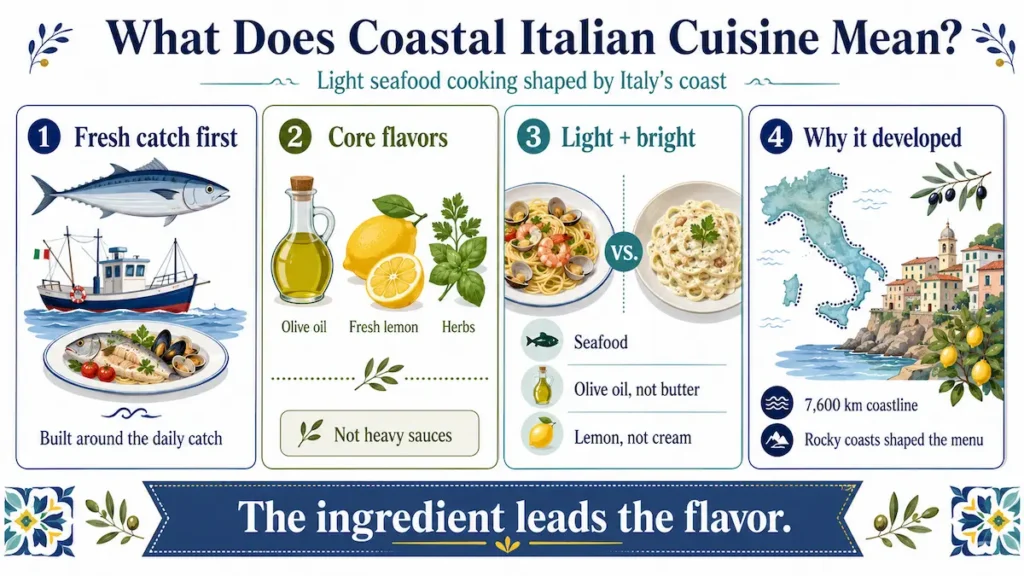
Coastal Italian cuisine means food built around what fishermen catch each morning. The dishes use olive oil instead of butter, fresh lemon instead of heavy cream, and herbs like basil and parsley instead of thick sauces.
Italy has more than 7,600 kilometers, nearly 4,700 miles, of coastline according to the CIA World Factbook. That much coast means seafood has shaped Italian cooking for centuries. A plate of coastal Italian food looks light and bright. The flavors come from the ingredient itself, not from a sauce covering it up.
This approach works because Italian coastal towns never had easy access to heavy dairy. Cows need pasture, and rocky coastlines do not offer much of it. Fishermen and farmers cooked with what grew nearby: olive trees, citrus groves, and the daily catch. That history still shapes every coastal Italian menu today.
How Coastal Italian Food Differs from Red Sauce Italian-American Cooking
Red sauce Italian-American food leans on tomato sauce, heavy cheese, and rich meat dishes like chicken parmesan. Coastal Italian food skips most of that. A coastal kitchen serves branzino instead of chicken parm. It uses a squeeze of lemon and good olive oil instead of marinara.
The pasta might carry clams and white wine instead of red sauce and sausage. Both styles come from Italy, but they come from different tables. Red sauce cooking grew in Italian-American neighborhoods. Coastal Italian cooking stayed close to the water.
The Italian Regions Behind Coastal Cuisine
Four regions shape most of what people call coastal Italian food today.
- Liguria gave the world pesto alla genovese and focaccia, both built from local basil and olive oil.
- Campania, home to Naples and the Amalfi Coast, is where spaghetti alle vongole and limoncello come from.
- Sicily adds arancini, caponata, and granita, with flavors shaped by North African trade routes.
- Sardinia keeps things simple with bottarga and fregola, letting the catch of the day speak for itself.
Each region uses what the local coast provides. That is the real definition of coastal Italian cuisine: cooking shaped by the water nearby.
Naples sits in Campania, which explains why so many coastal Italian menus in the United States lean on Neapolitan dishes. A restaurant that calls itself coastal Italian often pulls its strongest dishes from this one region, then adds a few plates from Sicily or Liguria for variety.
Core Ingredients in Coastal Italian Cooking
A coastal Italian kitchen leans on a short list of ingredients used well.
- Olive oil replaces butter as the main fat in most dishes.
- Fresh lemon cuts through rich seafood and brightens every plate.
- Basil, oregano, and parsley add flavor without hiding the main ingredient.
- Shellfish, including clams, mussels, and shrimp, appear across nearly every regional menu.
- White wine shows up in sauces and on the table alongside the meal.
These ingredients work together because none of them fight for attention. Each one supports the seafood instead of covering it.
Signature Coastal Italian Dishes to Know
A few dishes show up again and again across coastal Italian menus.
- Spaghetti alle vongole: pasta with clams, garlic, olive oil, and white wine.
- Cacciucco: a Tuscan fish stew built from the day’s catch.
- Fritto misto: lightly fried mixed seafood, served with lemon.
- Branzino al sale: whole sea bass baked in a salt crust to lock in moisture.
- Arancini: fried rice balls filled with ragu, cheese, or seafood.
- Caponata: a sweet and sour eggplant dish from Sicily.
Learning these names helps you order with confidence at any coastal Italian restaurant, including our own dinner menu here in Naples.
Wine and Drink Pairings for Coastal Italian Food
Light, high-acid white wines pair best with coastal Italian cooking because the food itself is light. Vermentino from Liguria matches seafood pasta well. Falanghina from Campania pairs with fried seafood and shellfish. Fiano brings enough body to stand up to grilled fish. An Aperol spritz works as a starter before the meal, cutting through rich appetizers like burrata or cured meats. The goal with any pairing is balance. Nothing should overpower the fish.
How to Spot Coastal Italian Cuisine on a Menu
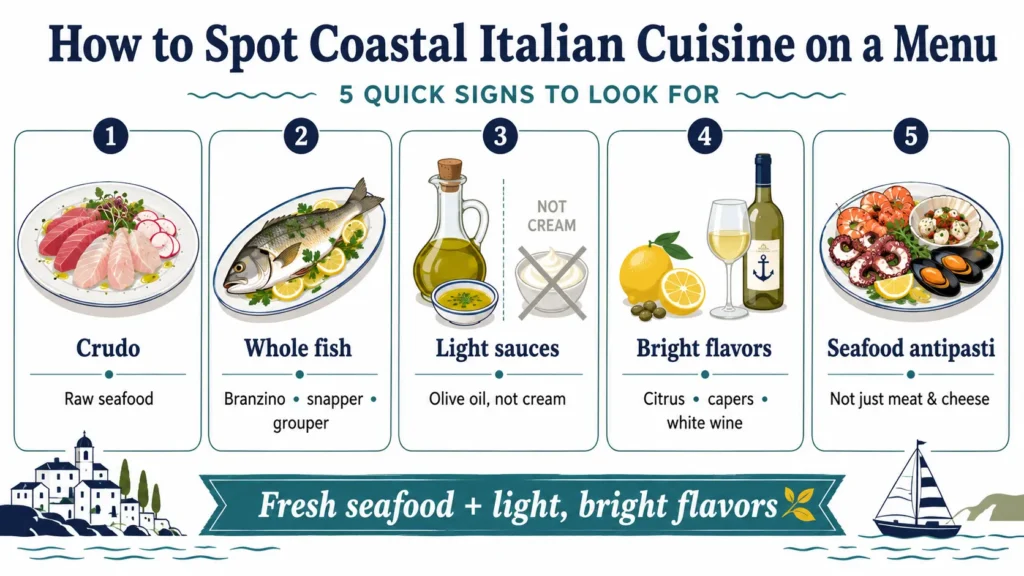
A few signs tell you a restaurant serves real coastal Italian food.
- The menu lists crudo or raw seafood preparations.
- Branzino, snapper, or grouper appear as whole-fish options.
- Sauces are described as olive-oil-based instead of cream-based.
- Citrus, capers, or white wine show up in the dish descriptions.
- Antipasti includes seafood, not just cured meat and cheese.
If a menu checks most of these boxes, you have found a coastal Italian kitchen.
Coastal Italian Cooking in Naples, FL
Naples, FL sits on the Gulf of Mexico, which gives local kitchens the same advantage Italian coastal towns have always had: fresh, local seafood. MiraMare Ristorante brings coastal Italian cooking to Naples using Gulf grouper, shrimp, and snapper instead of Mediterranean catch, paired with the same olive oil, citrus, and herb-driven approach used in Liguria and Campania.
Guests searching for Naples seafood restaurants with fresh, local catch will find that same philosophy on our menu, built around what local boats bring in that day rather than what sits in a freezer. It carries the same coastal Italian idea, with a Gulf Coast address.
Our chefs check the day’s catch before they plan the seafood specials. That means the branzino on the menu tonight might become grouper tomorrow, depending on what local boats bring in. Diners in Naples, FL get the same freshness that made this style of cooking famous along the Italian coast, just closer to home.
MiraMare Ristorante Naples FL
Frequently Asked Questions
Is coastal Italian cuisine the same as Mediterranean cuisine?
No. Mediterranean cuisine covers many countries around the sea, including Greece and Spain. Coastal Italian cuisine is specific to Italy’s coastal regions and their local dishes.
What makes a restaurant coastal Italian instead of just Italian?
A coastal Italian restaurant builds its menu around seafood, olive oil, and citrus instead of red sauce and heavy cheese. The dishes lean light instead of rich.
What seafood is used most in coastal Italian cooking?
Clams, shrimp, branzino, and mussels show up most often. Coastal Italian kitchens use whatever the local water provides that day.
Is coastal Italian cuisine healthy?
Yes. It relies on olive oil, lean seafood, and fresh vegetables instead of heavy cream and fried, breaded meats, which makes it a lighter style of Italian cooking overall.
Taste Coastal Italian Cuisine in Naples, FL
MiraMare Ristorante brings the full range of coastal Italian cooking to Naples, FL, from spaghetti alle vongole to whole branzino baked in a salt crust. Call (239) 430-6273 to book a table, or reserving online through Make a Reservation.